


THE MODERN FOREHAND
The Millennium Forehand Revisited — Biomechanics, Racquet Speed & Spin Control
The ACE System: Preparation • Hitting Zone • Ending
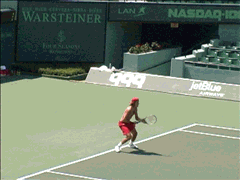
Original moving demonstration retained from the source article.
The term “Millennium Forehand” was used in the original article to describe a modern forehand pattern characterised by a compact, high-speed preparation, a forward-and-upward hitting action, and a finish that wraps across the body rather than simply finishing over the shoulder.
The coaching idea remains valuable, but the biomechanics can now be described more precisely. The finish is not a magic mechanism that independently creates spin or controls depth. Instead, it is the visible end-product of a sequence involving lower-body organisation, pelvic and trunk rotation, upper-arm and forearm rotations, racquet-head trajectory, racquet-face orientation and impact timing.
Modern research supports the broad concept of a high-speed, spin-capable forehand, but it also shows substantial variation between players and stroke intentions. Topspin and flatter drives can differ in the horizontal and vertical components of racquet velocity and in upper-limb kinematics. The goal, therefore, is not to copy one fixed pose but to reproduce the movement relationships that create the intended ball.
1. What the Millennium Forehand Really Represents
The original article identified an important evolution in forehand technique: contemporary players can generate very high racquet-head speeds while maintaining control of ball height, spin and depth. The modern forehand is better understood as an adaptable movement system rather than a single prescribed finish.
The characteristic “closed” finish — with the hitting-side forearm and racquet wrapping across the body — is common in high-level forehands. Players can arrive at that appearance through different combinations of stance, trunk rotation, arm rotation, racquet trajectory and impact conditions.
Research comparing flat and topspin forehands supports this variability. Topspin strokes generally involve greater vertical racquet-head velocity and different upper-limb rotation patterns, while flatter strokes place relatively more emphasis on forward racquet velocity.

Original annotated still: the source article's visual reference for the modern preparation.

Original moving sequence retained: modern forehand movement pattern.
2. The Three Phases of the ACE Forehand
The ACE System provides a useful coaching structure because it separates the stroke into three observable phases:
A — ARRIVE & ORGANISE: preparation, spacing, stance and body coil.
C — CONNECT & CONTROL: the hitting zone, impact conditions and racquet-head trajectory.
E — EXIT & COMPLETE: deceleration, trunk rotation, finish and recovery.
These phases should not be interpreted as three independent movements. They overlap. Preparation establishes the conditions for the hitting zone; the hitting zone determines the ball's launch conditions; and the ending is largely the visible result of what happened before and through impact.
For coaching, this is crucial. A player who is late should not automatically be told to “finish better.” The coach should first identify whether the problem began with positioning, preparation timing, spacing, sequencing or impact conditions.
3. Position One — Preparation
The original article describes Position One as beginning with a split step, followed by the pivot, torso coil and racquet preparation. That remains an excellent coaching model, but the modern interpretation is dynamic rather than static.
The player is attempting to organise the body early enough that the racquet and trunk are prepared before the final approach to the ball. The exact appearance varies with the incoming ball, stance and available time.
The non-hitting arm remains particularly useful as an organisational reference. Reaching across the body helps initiate thoracic rotation and establishes a relationship between the shoulders, pelvis and racquet. Elite forehand performance is associated not simply with large rotations, but with the timing of pelvic and trunk rotation relative to later movements of the shoulder and racquet.

Original moving preparation sequence retained.

Original moving sequence showing the relationship between preparation and body rotation.

Original annotated still: the non-hitting arm and trunk organisation.
4. The Racquet Take-Back — High, but Relaxed
The original article places considerable emphasis on a relatively high racquet-hand position. The useful modern principle is not a universal shoulder-height measurement; it is that the racquet should be organised early enough to allow smooth acceleration into the hitting zone.
A relaxed arm is important. Excessive muscular tension during preparation can restrict the subsequent sequencing of the trunk, shoulder and racquet. The player should arrive at the end of the preparation with enough time and space to accelerate rather than rush.
A higher preparation can contribute to a useful drop-and-accelerate pattern, but it is better explained as a combination of gravity, segmental rotation and active muscular contribution than as a simple use of “gravity and centrifugal force.”
Research does not support treating one exact racquet angle or one exact hand height as a universal law. A systematic review found substantial variation between studies and players, reflecting differences in skill level, stroke type and measurement methods.

Original moving sequence: preparation and racquet organisation.

Original annotated still showing the preparation reference points.
5. Position Two — The Hitting Zone
The original article identifies the contact point as the key reference point for consistency. That remains one of the strongest coaching concepts in the piece, provided “replication” is interpreted as functional consistency rather than an identical geometric location on every ball.
A player's ideal contact location changes with ball height, speed, spin, court position and tactical intention. What should remain stable is the player's ability to organise the body and racquet so that impact occurs within a controllable region in front of the body, with an appropriate racquet-face orientation and racquet-head trajectory.
Contact in front gives the player time and space to accelerate the racquet and manage the direction of the outgoing ball. It also allows the trunk and upper-limb rotations to contribute to racquet-head speed rather than forcing the player to rescue a ball that has travelled too far behind the body.
Biomechanical studies show that racquet-head trajectory and impact orientation are important determinants of topspin. Greater ball topspin is associated with a more closed racquet-face orientation and greater vertical racquet-head velocity immediately before impact.

Original annotated still: the source article's contact-point reference.

Original moving contact sequence retained.

Original moving sequence showing the forehand hitting action.
6. Contact Height — A Target, Not a Law
The original article uses waist height as its principal reference. That is an excellent training target for many neutral rally balls because it places the player in a relatively comfortable mechanical window. It should not, however, become a rigid rule.
High balls, low balls, wide balls and balls taken early all require different joint configurations. The skilled player adapts the legs, pelvis, trunk and hitting arm while preserving the essential relationships of spacing, timing and racquet control.
The key coaching question is therefore: “Can the player repeatedly create a stable, effective impact window?” rather than “Did the ball pass exactly through the same height every time?”
This interpretation is consistent with the research literature: different forehand types can show meaningful differences in racquet velocity and joint movement while still sharing broadly similar impact configurations.
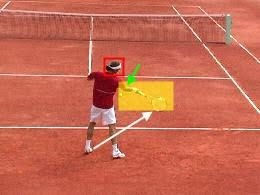
Original annotated contact-point reference retained.

Original still demonstrating the intended impact relationship.
7. Position Three — The Ending
This is the feature that gave the original Millennium Forehand its identity. The racquet and forearm wrap across the body, commonly finishing around the opposite side of the torso or shoulder region.
The important modern interpretation is that the finish is an outcome of the stroke's angular momentum and deceleration strategy. It is not necessary to force the racquet to a particular anatomical landmark. The body should be allowed to continue rotating while the arm and racquet progressively decelerate.
The forearm and racquet may finish low, around the opposite elbow or higher toward the opposite shoulder depending on the incoming ball, intended trajectory, spin and tactical objective. These are variations of a common movement family, not three entirely different forehands.
Research comparing topspin and flat forehands shows that topspin production is associated with changes in upper-limb kinematics, including greater forearm pronation and different humeral rotation patterns during the forward swing and follow-through.

Original moving sequence showing the characteristic modern finish.

Original moving sequence retained: completion of the stroke.
8. Does the Finish Control Depth?
The original article makes a useful coaching claim: that the finishing position can help regulate the effective length of the hitting zone. The modern biomechanical explanation needs one important refinement.
A player does not literally keep the ball on the strings for a longer period by extending the hitting zone. Ball-racquet contact lasts only a few milliseconds. Instead, the player changes racquet-head trajectory, speed, face orientation and swing direction through the impact window. The visible finish is evidence that those variables continued in a particular direction after impact.
Thus, “close the stroke earlier” can be an excellent external coaching cue when it helps the player produce a more upward, rotational and controlled stroke. It should not be taught as though the finish itself reaches back in time to determine what happened at impact.
This distinction preserves the powerful coaching idea while bringing its explanation into line with modern biomechanics.

Original moving sequence illustrating the finishing pattern.

Original annotated still: shoulder rotation and racquet finish.
9. Spin, Speed and the Three Ending Variations
The original article describes three broad finishing locations: near the opposite hip, around the opposite elbow, and higher toward the opposite shoulder. These remain useful coaching descriptions, provided they are treated as outcomes rather than mechanical switches.
Lower finish: commonly associated with a more pronounced upward racquet trajectory and heavy topspin intention.
Middle finish: a useful all-purpose modern forehand pattern combining substantial racquet speed with moderate-to-high topspin.
Higher finish: often associated with a more forward-directed ball trajectory and flatter intent.
The crucial point is that topspin is determined primarily around the impact event: racquet-face orientation, racquet-head velocity, the direction of the racquet path and the racquet-ball interaction. Research supports a greater vertical component of racquet velocity for topspin strokes and different upper-limb rotational patterns compared with flatter drives.
Therefore, do not teach the player that “finishing lower creates topspin.” Teach the player to create the appropriate racquet trajectory and impact conditions, then allow the racquet to finish naturally.

Original still illustrating the finishing position.

Original moving sequence retained: complete forehand action.
10. The Complete ACE Forehand
The modern forehand can be summarised as a sequence of coordinated events:
ARRIVE — use the split and movement to organise spacing before the ball arrives.
ORGANISE — rotate the pelvis and trunk while the racquet is prepared early enough to avoid a rushed backswing.
CONNECT — enter the hitting zone with appropriate spacing and a controllable impact point in front of the body.
ACCELERATE — allow the lower body, pelvis, trunk, shoulder, forearm and hand to contribute in sequence rather than attempting to generate all racquet speed from the arm.
EXIT — continue the movement through impact and allow the racquet to wrap across the body as the kinetic chain decelerates.
RECOVER — regain a balanced court position and prepare for the next ball.
Elite players are not necessarily distinguished by having dramatically larger movements. Timing is critical. Research comparing skill levels found that the timing of peak pelvis and trunk rotation helped distinguish elite from high-performance players, with the elite group tending to achieve higher horizontal shoulder and racquet velocities.

Original final moving demonstration retained from the source article.
11. Practical Coaching Progression
Stage 1 — Shadow the preparation. Establish the relationship between split, pivot, trunk coil and racquet organisation.
Stage 2 — Feed predictable balls. Focus on spacing and a stable impact window rather than trying to maximise racquet speed.
Stage 3 — Add topspin intention. Increase the vertical component of the racquet trajectory while maintaining control of the racquet face.
Stage 4 — Add movement. Make the player organise the same principles from different court positions.
Stage 5 — Add decision-making. Vary depth, height, spin and direction so the player must adapt rather than reproduce a rigid pattern.
Stage 6 — Video analysis. Compare preparation, impact and finish as a sequence rather than judging isolated positions.
The original article finishes with a mirror-and-video approach. That remains highly useful, but the modern progression should move from static awareness to representative movement.
The most useful video question is not “Does the player look exactly like Federer, Haas or Safin?” It is: “Does the player's movement consistently create the impact conditions required for the intended ball?”
12. The Modern Forehand Checklist
Is the player organising early enough to avoid a rushed forward swing?
Does the preparation involve the trunk and pelvis rather than an isolated arm take-back?
Is the player creating usable space between the body and the ball?
Does contact occur sufficiently in front to allow acceleration and directional control?
Is the racquet-face orientation appropriate for the intended ball?
Is the racquet moving sufficiently upward when topspin is required?
Is racquet speed generated through coordinated segmental rotation rather than excessive arm effort?
Does the player remain balanced through impact?
Does the racquet wrap naturally across the body as the stroke decelerates?
Can the same principles survive when the ball is high, low, wide, fast or short?
The Millennium Forehand remains a useful coaching concept because it captures a genuine feature of the modern forehand: players can combine very high racquet-head speed with substantial spin and still control the ball. The deeper lesson, however, is not the finish itself. It is the coordination of preparation, spacing, impact and deceleration that makes the modern forehand so effective.
References & Modern Biomechanical Context
Genevois, C., Reid, M., Creveaux, T., & Rogowski, I. (2020). Kinematic differences in upper limb joints between flat and topspin forehand drives in competitive male tennis players. Sports Biomechanics, 19(2), 212–226.
Lambrich, J., & Muehlbauer, T. (2023). Biomechanical analyses of different serve and groundstroke techniques in tennis: A systematic scoping review. PLOS ONE, 18(8), e0290320.
Influence of Tennis Racquet Kinematics on Ball Topspin Angular Velocity and Accuracy during the Forehand Groundstroke (2017).
Key Factors and Timing Patterns in the Tennis Forehand of Different Skill Levels (2010).
The role of upper limb segment rotations in the development of spin in the tennis forehand (1996).
Editorial note: The original coaching framework, ACE terminology and visual demonstrations have been retained where useful. Dated or overly absolute claims have been reframed using contemporary biomechanical evidence, particularly where the original article treated a specific joint angle, contact height or finish location as universal.

Comments