


THE SLICE BACKHAND
Updated: 2 days ago
The ACE System — Modern Biomechanics, Technique & Tactics
Technique, Biomechanics & Tactical Application

Original player imagery retained and visually cleaned from the supplied document.
1. Why the slice backhand matters
The slice backhand is one of the most tactically versatile shots in tennis. Its value is not simply that it can be used under pressure. A well-executed slice can alter the opponent's available time, contact height, court position, rhythm and options on the following ball.
Roger Federer provides an exceptional example because of the extraordinary range with which he employed the shot: neutralising high-speed balls, returning serve, changing direction, approaching the net, defending from wide positions and creating short angles. The important lesson is not that every player should reproduce Federer's exact stroke, but that sound mechanics give the player a larger tactical vocabulary.
Modern biomechanics strengthens this argument. Rather than searching for one 'perfect' slice position, we should identify stable principles that remain useful while the player adapts stance, contact height, racquet path and body configuration to the incoming ball.
THE MODERN COACHING PRINCIPLEA high-level slice is an adaptable whole-body movement. The player organises early, establishes the racquet-face relationship, controls the centre of mass and delivers the racquet through an appropriate contact window. The finish is primarily the consequence of these actions and of subsequent deceleration. |
2. The original players — retained as reference models
image5.jpg

image4.jpg

image6.jpg

image9.jpg

image8.jpg
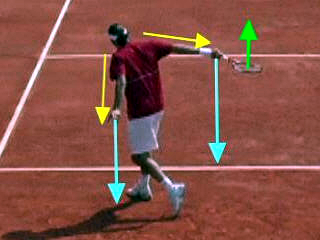
image7.jpg
3. A — ARRIVE & ORGANISE
Preparation is where the player buys time. The earlier the racquet and body are organised, the more freedom remains for perception, spacing and tactical choice.
Reference point 1: Early racquet organisation
The chapter called the final preparation position the 'Square' position and correctly recognised it as a useful visual reference. I would retain the concept, but change the language from 'exact position' to 'functional organisation'. The racquet, forearm and upper arm should arrive in a stable relationship early enough that the player does not have to construct the stroke at the last moment.
The exact elbow angle, racquet height and shoulder rotation will change with ball height, speed and intended shot. What should remain consistent is the player's ability to control racquet orientation and spacing before the forward swing begins.
Reference point 2: The shoulder girdle organises the take-back
The instruction to 'take the racquet back with the body' remains valuable. The modern explanation is that the trunk and shoulder girdle provide the proximal platform from which the hitting arm can operate. The arm is not passive; rather, the arm and trunk coordinate as one movement system.
For the one-handed backhand, research demonstrates distinctive upper-limb and trunk coordination patterns. This is one reason why simply prescribing a large arm take-back can produce a late, disconnected stroke: it increases the demand for rapid distal corrections close to impact.
Reference point 3: Racquet-face control
The chapter correctly warned against allowing the racquet face to become excessively open during preparation. The modern cue is: establish the racquet-face orientation early and preserve sufficient stability through the contact window.
A stable wrist–forearm relationship does not mean that the wrist is mechanically frozen. Small adjustments are part of skilled movement. The objective is to minimise unnecessary variability at impact, not to eliminate normal joint motion.
Reference point 4: Lower-body loading is adaptable
The instruction to load the right leg and step at approximately 45 degrees is useful for the particular stroke pattern illustrated, but it should not be presented as a universal biomechanical law. Modern movement analysis emphasises centre-of-mass control and the direction of ground-reaction forces. The loaded leg will change with stance, ball position, court location and movement demands.
In a neutral or closed-stance slice the player may load one leg strongly; in a running or stretched slice the lower-body solution may be completely different. The common objective is to arrive balanced enough to control the racquet and still be able to move after contact.
4. C — CONNECT & CONTROL
The hitting zone is where racquet velocity, racquet orientation, contact location and body position combine to determine the ball's launch conditions.
Reference point 1: Contact is a window, not a single position
The chapter was right to place enormous importance on contact. However, 'waist-to-chest height' and a fixed relationship to the front foot should be understood as broad reference cues. The optimal contact point changes with incoming ball height, speed, spin, player height, movement state and intended trajectory.
The more useful coaching question is: can the player consistently create a contact point that allows the racquet to travel through the intended launch window while maintaining balance and court position?

image2.jpg

image1.jpg

image3.jpg
Reference point 2: Racquet-head velocity is a coordinated outcome
Racquet-head speed is not generated by a single joint. Three-dimensional biomechanical research shows that the contribution of individual segments depends on their angular velocity and their changing spatial relationship to the racquet. In practical coaching terms, 'use the wrist' or 'use the arm' is therefore an incomplete instruction.
For the slice, the target is not maximum racquet speed in isolation. It is an appropriate racquet velocity vector: enough forward component to penetrate the court, enough downward component to produce the desired launch characteristics, and sufficient control of racquet orientation to direct the ball.
Reference point 3: Stable wrist–forearm relationship
The observation that the racquet head remains above the wrist at contact is a useful visual cue for the conventional slice, but it should not be treated as an absolute requirement. What matters mechanically is the racquet's orientation relative to the forearm and the ball at impact.
The player's sensation should be one of controlled transmission rather than a last-moment wrist flick. The wrist can move during the stroke, but the player should not need to manufacture underspin by rapidly opening the racquet face at impact.
Reference point 4: High-to-low AND through the ball
'High-to-low' remains a useful description of the classic slice path, but it can produce poor coaching if interpreted as a vertical chop. The racquet needs a downward component while continuing sufficiently forward through the contact zone. The balance between these velocity components is a major determinant of trajectory, depth and bounce behaviour.
Reference point 5: Visual stability
The instruction to keep the head quiet remains useful. Modern motor-control language would describe this less as 'freezing the head' and more as maintaining a stable visual reference during the final approach. Excessive head movement often indicates unstable footwork, late preparation or poor spacing.
5. E — EXIT & RECOVER
The end of the stroke is not merely a pose. It is the beginning of the next movement.
Reference point 1: The non-hitting arm as counterbalance
One of the strongest ideas in the chapter is the role of the non-hitting arm. Rather than thinking of it simply as something that is 'thrown back', it is better understood as part of whole-body angular-momentum management. As the racquet arm accelerates forward, movement of the opposite arm can help regulate trunk rotation and preserve balance.
This becomes especially important on running slices, forward-moving approaches and emergency defensive shots, where the player cannot rely on a perfectly symmetrical base.
Reference point 2: The finish is an outcome
The 'palms down' and 'touch the shoulder blades together' cues are memorable and can be useful external cues for some players. They should not, however, be presented as universal biomechanical requirements. A penetrating slice, short-angle slice and running slice may finish differently because the task and movement constraints are different.
Reference point 3: Deceleration and recovery
Elite performance depends not only on producing racquet speed but also on controlling it. The player must decelerate the racquet arm and trunk while maintaining sufficient postural control to recover. A technically impressive finish that leaves the player unable to move can still be a poor tennis stroke.
6. The slice is a family of shots
Neutralising slice
Absorb pace and change the opponent's contact conditions while maintaining enough depth to avoid handing over the initiative.
Penetrating slice
Increase forward racquet velocity while maintaining controlled underspin and a low, penetrating trajectory.
Approach slice
Use depth, low bounce and trajectory to make the opponent strike from a compromised height while moving forward.
Short-angle slice
Manipulate lateral trajectory and spin to pull the opponent outside the singles court.
Return slice
Compact the preparation and prioritise predictable direction and depth over elaborate swing amplitude.
Running / emergency slice
Allow the stance, loading pattern and racquet preparation to adapt to the movement constraint while preserving a playable trajectory.
Drop slice
Reduce forward velocity and adjust launch conditions to produce a short landing point while retaining the same fundamental organisation.
7. Common errors — interpreted biomechanically
Arm-only preparation
Late distal movement increases the need for rapid corrections near impact.
Racquet face opens excessively
The player must compensate during the final approach, increasing variability in launch direction and height.
Excessive downward chopping
The vertical component becomes too dominant and forward penetration is lost.
Trying to hold the wrist rigid
This can create unnecessary tension and reduce normal forearm/racquet coordination.
Forcing one stance
A fixed footwork pattern cannot accommodate the full range of ball speeds, heights and movement situations.
Trying to reproduce the finish
The player learns the visible consequence instead of the movement that produced it.
8. A modern coaching progression
1. Organise
Shadow the preparation from ready position. Emphasise early racquet control and trunk/shoulder organisation.
2. Stabilise spacing
Use predictable feeds and coach the player to arrive with the ball in a comfortable contact window.
3. Control the launch
Use target corridors to explore the relationship between racquet-face orientation, swing direction, depth and underspin.
4. Add movement
Introduce lateral, forward and running situations. Allow the lower-body solution to change.
5. Add tactical constraints
Alternate neutralising, penetrating, approach, short-angle and return slices.
6. Transfer to live play
Evaluate the quality of the next-ball situation, not merely whether the stroke matched a model photograph.
9. The movement sequence
The supplied animated sequence is retained and lightly enhanced. It should be viewed as a movement map rather than a template that every player must reproduce frame-for-frame.

Enhanced original GIF supplied within the document.
10. High-performance checklist
• Am I organised early enough that the racquet is already under control?
• Is my centre of mass positioned so I can control the stroke and still recover?
• Is the ball sufficiently in front for the shot I am trying to produce?
• Is the racquet face stable through the contact window?
• Am I moving through the ball rather than simply chopping down?
• Is the amount of underspin appropriate to the tactical intention?
• Does my non-hitting arm help me control rotation and balance?
• Can I decelerate and recover immediately after the stroke?
• Did the shot create the tactical effect I intended?
11. The central biomechanical idea
THE SLICE IS NOT A CHOP.It is a coordinated movement in which early organisation, whole-body positioning, racquet-face control, segmental motion, contact geometry and deceleration combine to produce a specific ball trajectory and tactical effect. The visible finish matters—but it is the consequence of the movement, not the mechanism that creates it. |
12. Biomechanical references
Sprigings, E., Marshall, R., Elliott, B. & Jennings, L. (1994). Three-dimensional kinematic analysis of arm segment rotations and racquet-head speed. Journal of Biomechanics.
Knudson, D. & Blackwell, J. (1997). Upper extremity angular kinematics of the one-handed backhand drive in tennis players with and without tennis elbow. International Journal of Sports Medicine.
Reid, M. et al. (2015). Performance factors related to different tennis backhand groundstrokes: a review. Journal of Sports Sciences.
Tanabe, S. & Ito, A. (2007). Three-dimensional analysis of upper-limb contributions to racquet-head velocity. Sports Biomechanics.
Wang, L-H. et al. (2010). Segmental linear and angular momentum transfers in two-handed backhand stroke stances. Journal of Science and Medicine in Sport.
Biomechanical analyses of different serve and groundstroke techniques in tennis: systematic scoping review (2023). PLOS ONE. DOI: 10.1371/journal.pone.0290320.
The complete slice
The most effective way to understand the slice is not as a single stroke shape, but as a movement solution. The player must organise early, arrive with appropriate spacing, control the racquet face, direct the racquet through the contact window and then decelerate in a way that leaves the body ready for what happens next.
That is also why the best slicers are difficult to read. Their preparation may look similar, yet the ball can leave the racquet with very different combinations of speed, spin, height, depth and direction. The underlying mechanics provide the platform; the tactical intention determines how that platform is used.
For the player, the objective is therefore not to manufacture a photograph-perfect finish. It is to develop a movement pattern sufficiently robust that it survives changing balls, changing positions and changing tactical demands. When that happens, the slice stops being a defensive alternative and becomes one of the most sophisticated tools available in the game.
References
Sprigings, E., Marshall, R., Elliott, B. & Jennings, L. (1994). Three-dimensional kinematic analysis of arm segment rotations and racquet-head speed. Journal of Biomechanics.
Knudson, D. & Blackwell, J. (1997). Upper extremity angular kinematics of the one-handed backhand drive in tennis players with and without tennis elbow. International Journal of Sports Medicine.
Reid, M. et al. (2015). Performance factors related to different tennis backhand groundstrokes: a review. Journal of Sports Sciences.
Tanabe, S. & Ito, A. (2007). Three-dimensional analysis of upper-limb contributions to racquet-head velocity. Sports Biomechanics.
Wang, L-H. et al. (2010). Segmental linear and angular momentum transfers in two-handed backhand stroke stances. Journal of Science and Medicine in Sport.
Biomechanical analyses of different serve and groundstroke techniques in tennis: systematic scoping review (2023). PLOS ONE. DOI: 10.1371/journal.pone.0290320.
Comments